
|
 |
has long been the leading international newsweekly of music, video and home entertainment.
We have a full set of these magazines for the years 1972 to 2004. We also have some issues from 1965/6.
|
|
 |
magazine was a weekly US-based music industry publication, which was published weekly until it closed in November 1996.
We have 260 of these magazines from the years 1974 to 1981
|
|
 |
Originally founded as Hullabaloo in 1966, dates from 1968. It started out as a general interest rock magazine before focusing on heavy metal and hard rock bands.
We have many issues dating from 1969 to 1985
|
|
 |
was a "special issue" offshoot of Circus, generally focusing on single acts popular with the magazine's readers.
We have many issues dating from 1974 to 1975
|
|
 |
was the granddaddy of all music mags, originally launched by Paul Williams as a modest fanzine in 1966. It later turned into a monthly glossy before its demise in the late '70s.
We have many issues dating from 1976 to 1978
|
|
 |
was the legendary Detroit-based monthly magazine that started publication in 1969. For some years it was America's coolest rock mag, featuring the work of the legendary Lester Bangs and others.
We have most issues dating from 1971 to 1988
|
|
 |
was a weekly British publication with an essentially pop slant, in contrast to the more rock-centric NME and Melody Maker.
|
|
 |
Founded in 1988, is a monthly for collectors of rock, pop, country & western, R & B, doo wop, and jazz.
|
|
 |
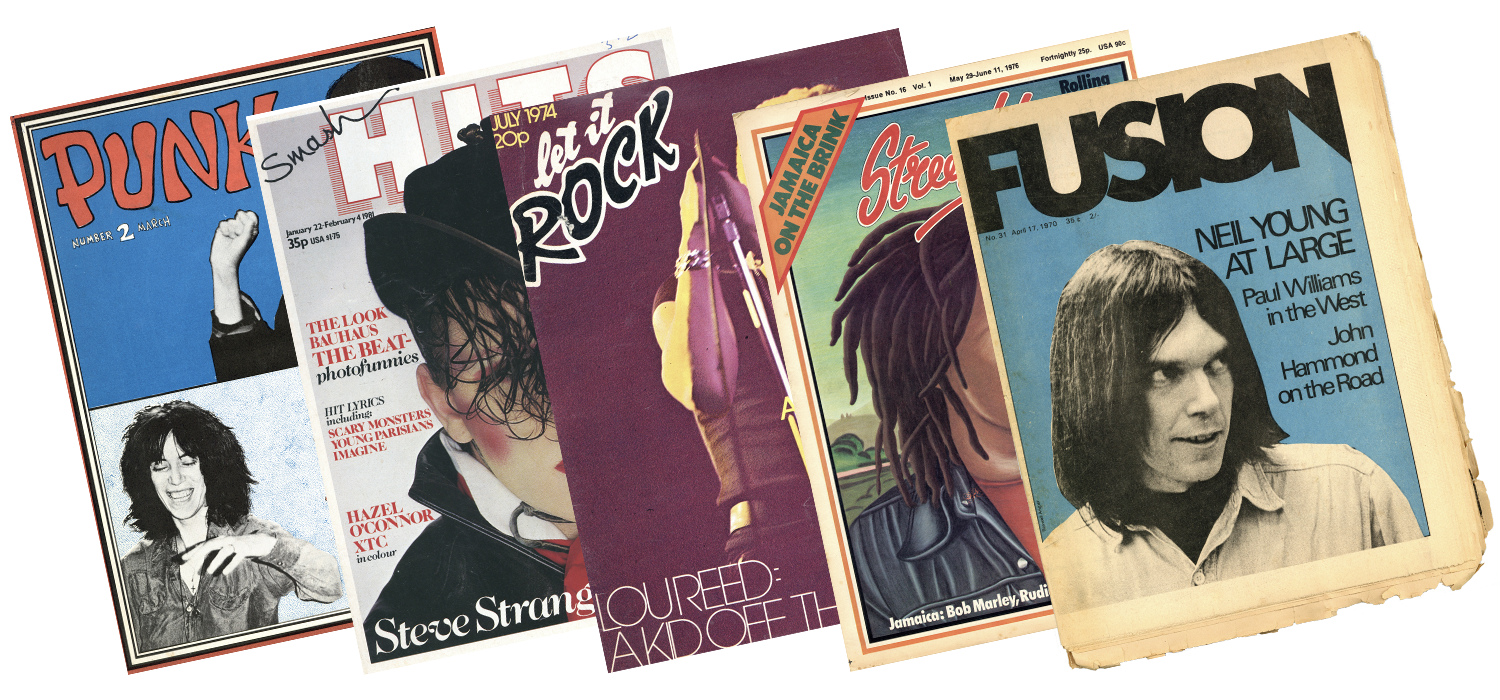
was a Rolling Stone-esque rock broadsheet founded in Boston in the late '60s. Writers included Lenny Kaye, Robert Greenfield and others.
We have most issues from 1969 to 1974
|
|
 |
has long been the ultimate monthly for record collectors. Also features long in-depth articles and some reviews.
We have most issues for the last thirty years.
|
|
 |
is the monthly UK bible of Heavy Metal and hard rock.
We have issues for 1987, 1992 to 1996 and 2004
|
|
 |
Until its demise in 2000, was the world's oldest music magazine, founded in 1926 as "a monthly magazine for all who are directly or indirectly interested in the production of popular music".
We have most issues from 1973 to 1986, and 1993 to 2000.
|
|
 |
was launched in 1994 as a retrospective-leaning monthly with in-depth articles on canonical artists such as Dylan and the Beatles.
We have all issues up to 2003.
|
|
 |
is the last remaining UK rock weekly, for over three decades the ultimate arbiter of what's hip in popular music.
We have almost all issues from 1970-1989.
|
|
 |
Founded in 1986 by Mark Ellen and David Hepworth, brought the rock giants of the '60s and '70s back into the arena of music journalism, tapping a hidden market of older readers.
We have most issues to 2009
|
|
 |
is a weekly newspaper providing the radio and recording industries with the very latest in news, sales, marketing innovations, and airplay data. We have issues from the years 1987 to 1989.
|
|
 |
was a hard-rock-friendly monthly launched by EMAP to complement the more metallic Kerrang!
|
|
 |
was a pop-oriented weekly that up to its closure in 1991 was particularly respected for its coverage of dance music.
|
|
 |
was a trade monthly for the US music industry.
|
|
|
 |
started publication in San Francisco in November 1967. It quickly became regarded as America's foremost contemporary music magazine, and the voice of the political counterculture.
We have some issues from 1969, and all issues from 1970 to 1978, 1980 to 1982, 1987, 1989, 1991, 1992, 1994 and 2000 to 2002.
|
|
 |
Launched by former NME editor Nick Logan, tapped into the teenage pop market of the early '80s and quickly became the biggest-selling music publication in Britain.
|
|
 |
Until its demise, magazine was one of the three leading music weeklies in the UK. Strong on hard rock, it beat the NME to the punch with early coverage of punk.
We have all issues from 1976 to 1985, and for 1987 and 1991
|
|
 |
Launched as Trans-Oceanic Trouser Press in early 1974, Ira Robbins' monthly paid particular attention to the more interesting UK bands of the '70s and '80s.
|
|
 |
is an IPC monthly launched to compete with EMAP's MOJO. Carries extensive features and interviews with canonical UK/US acts.
|
|
 |
A precursor to Uncut, was an IPC weekly launched to compete with EMAP's Q. Unlike Uncut, it failed.
|
|
 |
Founded by Pete (Family Trees) Frame, was a superior fanzine dedicated to all things West Coast and be-denimed in the early '70s. Later had a punk makeover.
We have most issues from 1971 to 1980
|
|
|